Is Zepbound the same thing as Mounjaro?
What is Zepbound vs Mounjaro, and which is better?
Yes, they are the same medicine. Both are tirzepatide, made by Eli Lilly, and both are once-weekly injections with the same doses, 2.5 mg to 15 mg. The difference is the FDA label. Mounjaro is approved for type 2 diabetes. Zepbound is approved for long-term weight management and for obstructive sleep apnea in adults with obesity.[1][2]

Mounjaro vs Zepbound at a glance
Prices checked October 3, 2026.
| Attribute | HIGHLIGHTED Mounjarotirzepatide | Zepbound tirzepatide |
|---|---|---|
| Active ingredient | tirzepatide | tirzepatide |
| Manufacturer | Eli Lilly | Eli Lilly |
| Drug class | Dual GIP / GLP-1 receptor agonist | Dual GIP / GLP-1 receptor agonist |
| FDA approved | May 2022 | November 2023 |
| Indication | Type 2 diabetes (adults and ages 10+). Also lowers heart risk in type 2 diabetes at high risk[1] | Chronic weight management (adults) and moderate to severe obstructive sleep apnea in adults with obesity[2] |
| Dose schedule | Subcutaneous injection · Once weekly[1] | Subcutaneous injection · Once weekly[2] |
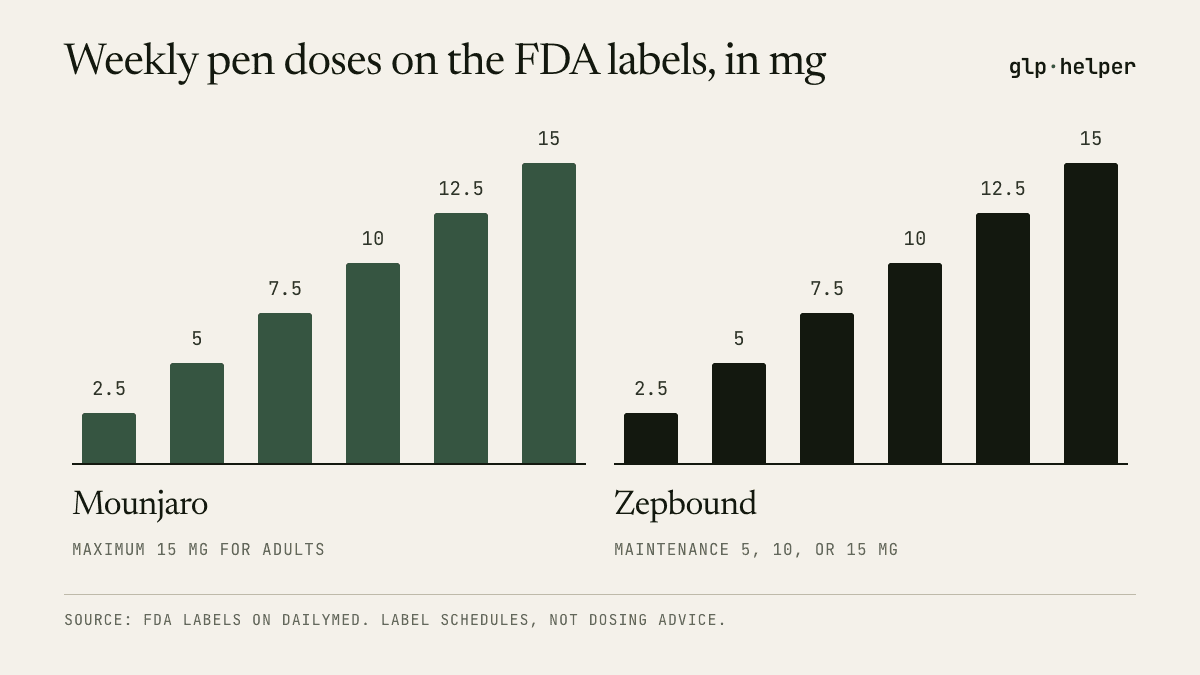
| Available doses | 2.5 mg · 5 mg · 7.5 mg · 10 mg · 12.5 mg · 15 mg[1] | 2.5 mg · 5 mg · 7.5 mg · 10 mg · 12.5 mg · 15 mg[2] |
| Mechanism | Tirzepatide is a first-in-class single molecule that activates both the GIP and GLP-1 receptors. The dual incretin action augments glucose-dependent insulin secretion, suppresses glucagon, slows gastric emptying, and reduces appetite. It produces larger average HbA1c and weight reductions than GLP-1 agonism alone in head-to-head trials. | Tirzepatide is a first-in-class single molecule that activates both the GIP and GLP-1 receptors. The dual incretin action slows gastric emptying and reduces appetite via central nervous system pathways while improving glucose handling. It produces larger average weight loss than single GLP-1 agonists in its obesity trials. |
| Common side effects | Nausea (12 to 18%), diarrhea (12 to 17%), vomiting (5 to 9%) at 5 mg to 15 mg. Most reports came during dose escalation[1] | Nausea (25 to 29%), diarrhea (19 to 23%), vomiting (8 to 13%) at 5 mg to 15 mg. Most reports came during dose escalation[2] |
| Cost range | List price $1,112.16 a month. Self-pay pen $499 through Lilly. As little as $25 with commercial insurance and the savings card[4][5][6] | List price $1,086.37 a month. Self-pay KwikPen $299 to $699 by dose through Lilly, vial from $299. As little as $25 with commercial insurance and the savings card[7][8] |
This comparison is for education only and is not medical advice. Mounjaro and Zepbound are prescription medicines with distinct FDA-approved indications. Whether either is appropriate for you, and at what dose, is a decision for a licensed clinician.
Why does my insurance cover Mounjaro but not Zepbound?
Each brand carries its own FDA approval. Mounjaro is approved to lower blood sugar in type 2 diabetes, in adults and children 10 and older, and to lower heart attack and stroke risk in adults with type 2 diabetes at high risk. Zepbound is approved for weight management and sleep apnea in adults. Insurers cover each brand by its label, so a plan may pay for one and not the other. The $25 savings card price needs a commercial plan that covers that brand. Without that coverage, each card brings a one-month pen fill to as low as $499.[1][2][5][8]
Which is better, Mounjaro or Zepbound?
Neither. The drug is the same, so the difference is which use it is approved for. Trial numbers differ because the people differ. In SURMOUNT-1, adults with obesity and no diabetes lost 20.9% of their body weight on 15 mg at 72 weeks, versus 3.1% on placebo. That trial is the basis for Zepbound's weight approval. The Zepbound weight loss calculator and the Mounjaro weight loss calculator chart average loss week by week from trial data.[3]
Are Mounjaro and Zepbound doses the same?
The pens come in the same six strengths, 2.5 mg to 15 mg, and both start at 2.5 mg once a week. The labels differ after that. Zepbound steps up by 2.5 mg after at least 4 weeks at each dose, to a maintenance dose of 5 mg, 10 mg, or 15 mg for weight, or 10 mg or 15 mg for sleep apnea. Its 2.5 mg dose is only for starting. Mounjaro steps up in 2.5 mg increments after at least 4 weeks if more blood sugar control is needed, to a maximum of 15 mg for adults and 10 mg for children. These are label schedules, not a guide to what any one person should take.[1][2]
| Stage | Mounjaro | Zepbound |
|---|---|---|
| Starting dose | 2.5 mg once a week | 2.5 mg once a week for 4 weeks |
| Step-up | 2.5 mg more after at least 4 weeks, if more blood sugar control is needed | 2.5 mg more after at least 4 weeks |
| Maintenance for weight | Not approved for weight | 5 mg, 10 mg, or 15 mg |
| Maintenance for sleep apnea | Not approved for sleep apnea | 10 mg or 15 mg |
| Maximum dose | 15 mg for adults. 10 mg for children 10 and older | 15 mg |
Which has more side effects, Mounjaro or Zepbound?
The drug is the same, but the trials enrolled different people. In Mounjaro's diabetes trials, nausea was reported by 12% to 18% of adults on 5 mg to 15 mg. In Zepbound's weight trials, it was 25% to 29% at the same doses. On both labels, most nausea, vomiting, and diarrhea came during dose escalation and eased over time.[1][2]
| Side effect | Mounjaro 5 mg to 15 mg | Zepbound 5 mg to 15 mg |
|---|---|---|
| Nausea | 12% to 18% | 25% to 29% |
| Diarrhea | 12% to 17% | 19% to 23% |
| Vomiting | 5% to 9% | 8% to 13% |
| Constipation | 6% to 7% | 11% to 17% |
| Abdominal pain | 5% to 6% | 9% to 10% |
| Stopped for stomach side effects | 3.0% to 6.6% | 1.9% to 4.3% |
What is cheaper, Zepbound or Mounjaro?
At list price they are close: Mounjaro is $1,112.16 a month and Zepbound is $1,086.37. Paying cash through Lilly, Zepbound is cheaper at low doses. Zepbound KwikPens cost $299 at 2.5 mg and $399 at 5 mg, while Mounjaro pens start at $499 at every dose. From 7.5 mg up, a Zepbound first purchase or a refill within 45 days costs $449. With commercial insurance that covers the drug, each savings card can bring a fill to as little as $25. If a commercial plan does not cover it, each card can bring a one-month pen fill to as low as $499.[4][5][6][7][8]
Prices checked October 3, 2026.
| Monthly price | Mounjaro | Zepbound |
|---|---|---|
| List price | $1,112.16 | $1,086.37 |
| Self-pay through Lilly | From $499 at every dose | $299 for 2.5 mg, as a KwikPen or vial. KwikPen prices are $399 for 5 mg, $499 for 7.5 mg, and $699 for 10 mg, 12.5 mg, or 15 mg. A $449 price applies to 7.5 mg through 15 mg KwikPens on a first purchase and on refills within 45 days |
| Commercial insurance that covers it, with the savings card | As little as $25 | As little as $25 |
| Commercial insurance that does not cover it, with the savings card | As low as $499 | As low as $499 |
| Medicare | Savings card not available | No more than $50 under the Medicare GLP-1 Bridge |
Can you take Mounjaro and Zepbound together?
No. The Zepbound label says it is not recommended with other tirzepatide products, and Mounjaro is tirzepatide. Taking both would mean a double dose of the same drug.[2]
What is the strongest GLP-1 for weight loss?
No trial has compared every GLP-1 drug. Among those tested head to head, tirzepatide, the drug in both Mounjaro and Zepbound, led semaglutide in SURMOUNT-5: 20.2% versus 13.7% weight loss at 72 weeks. Compare Wegovy vs Zepbound and Mounjaro vs Ozempic.[9]
- FDA label, Mounjaro (tirzepatide) injection, Eli Lilly (DailyMed)
- FDA label, Zepbound (tirzepatide) injection, Eli Lilly (DailyMed)
- Jastreboff AM et al. Tirzepatide Once Weekly for the Treatment of Obesity. N Engl J Med 2022;387:205-216 (SURMOUNT-1) (NEJM)
- Mounjaro list price (wholesale acquisition cost), Lilly pricing information, read October 3, 2026 (Eli Lilly)
- Mounjaro savings card terms, read October 3, 2026 (Eli Lilly)
- Mounjaro self-pay price on LillyDirect, read October 3, 2026 (Eli Lilly)
- Zepbound list price and self-pay prices, Lilly pricing information, read October 3, 2026 (Eli Lilly)
- Zepbound savings card, self-pay offers, and the Medicare GLP-1 Bridge, read October 3, 2026 (Eli Lilly)
- Aronne LJ et al. Tirzepatide as Compared with Semaglutide for the Treatment of Obesity. N Engl J Med 2025;393:26-36 (SURMOUNT-5) (NEJM)