What is the difference between Ozempic and Mounjaro?
Does Mounjaro work better than Ozempic, and why?
Ozempic is semaglutide, which acts on one gut-hormone receptor, GLP-1. Mounjaro is tirzepatide, which acts on two, GIP and GLP-1. Both are once-weekly injections approved for type 2 diabetes. In SURPASS-2, which tested them against each other in 1,879 adults with type 2 diabetes, tirzepatide lowered HbA1c and body weight more than semaglutide 1 mg.[1][2][3]

Mounjaro vs Ozempic at a glance
Prices checked October 3, 2026.
| Attribute | HIGHLIGHTED Ozempicsemaglutide | Mounjaro tirzepatide |
|---|---|---|
| Active ingredient | semaglutide | tirzepatide |
| Manufacturer | Novo Nordisk | Eli Lilly |
| Drug class | GLP-1 receptor agonist | Dual GIP / GLP-1 receptor agonist |
| FDA approved | December 2017 | May 2022 |
| Indication | Type 2 diabetes (adults). Also lowers heart and kidney risks in type 2 diabetes with heart or kidney disease[1] | Type 2 diabetes (adults and ages 10+). Also lowers heart risk in type 2 diabetes at high risk[2] |
| Dose schedule | Subcutaneous injection · Once weekly[1] | Subcutaneous injection · Once weekly[2] |
| Available doses | 0.25 mg · 0.5 mg · 1 mg · 2 mg[1] | 2.5 mg · 5 mg · 7.5 mg · 10 mg · 12.5 mg · 15 mg[2] |
| Mechanism | Semaglutide is a GLP-1 analog with 94% homology to native human GLP-1. It binds the GLP-1 receptor, augmenting glucose-dependent insulin secretion, suppressing glucagon, slowing gastric emptying, and reducing appetite via central nervous system pathways. | Tirzepatide is a first-in-class single molecule that activates both the GIP and GLP-1 receptors. The dual incretin action augments glucose-dependent insulin secretion, suppresses glucagon, slows gastric emptying, and reduces appetite. It produces larger average HbA1c and weight reductions than GLP-1 agonism alone in head-to-head trials. |
| Common side effects | Nausea (15.8 to 20.3%), diarrhea (8.5 to 8.8%), vomiting (5 to 9.2%) at 0.5 mg and 1 mg. Most reports came during dose escalation[1] | Nausea (12 to 18%), diarrhea (12 to 17%), vomiting (5 to 9%) at 5 mg to 15 mg. Most reports came during dose escalation[2] |
| Cost range | List price $1,027.51 a month. Self-pay pen $349 to $499 through Novo Nordisk. As little as $25 with commercial insurance and the savings card[4][5] | List price $1,112.16 a month. Self-pay pen $499 through Lilly. As little as $25 with commercial insurance and the savings card[6][7][8] |
This comparison is for education only and is not medical advice. Ozempic and Mounjaro are prescription medicines with distinct FDA-approved indications. Whether either is appropriate for you, and at what dose, is a decision for a licensed clinician.
Does Mounjaro work better than Ozempic?
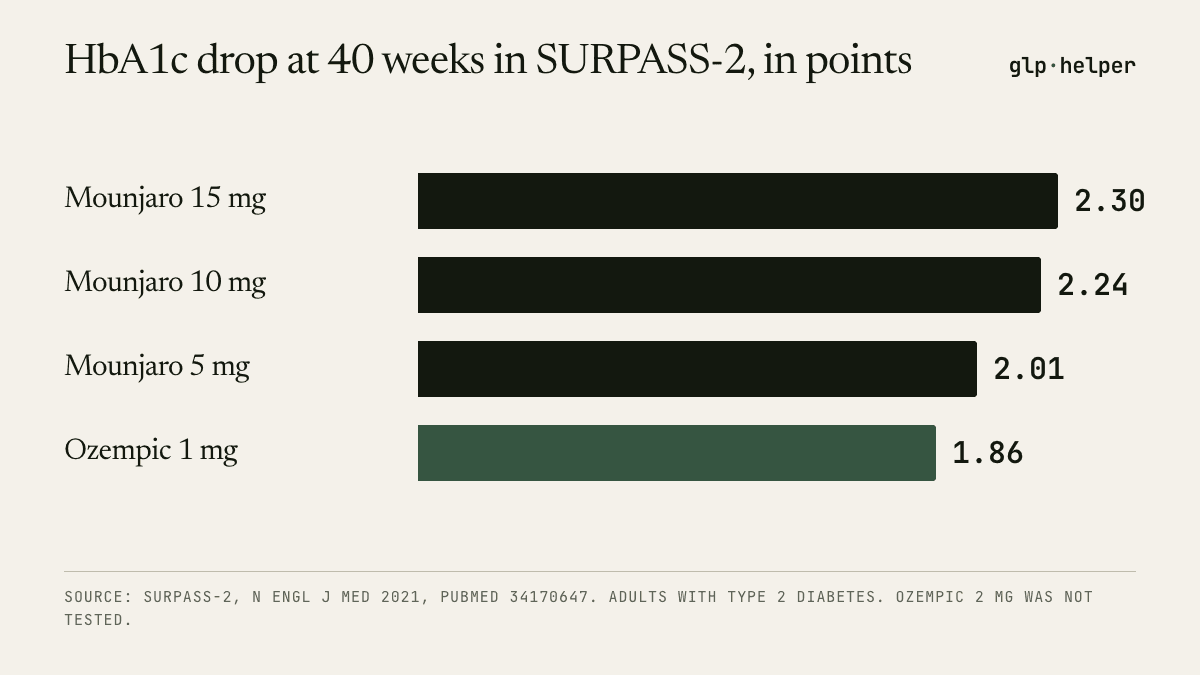
In SURPASS-2 it did, on both blood sugar and weight. Over 40 weeks, HbA1c fell 2.01, 2.24, and 2.30 points on tirzepatide 5, 10, and 15 mg, and 1.86 points on semaglutide 1 mg. Every tirzepatide dose beat semaglutide. Weight loss was 1.9, 3.6, and 5.5 kg greater on tirzepatide. The trial did not test Ozempic's 2 mg dose, and it was open-label.[3]
Which is stronger, tirzepatide or Ozempic?
On the doses tested, tirzepatide had the larger effect. In SURPASS-2, every tirzepatide dose lowered HbA1c more than Ozempic 1 mg, by 0.15 to 0.45 points, and cut 1.9 to 5.5 kg more weight. In SURMOUNT-5, a weight-loss trial in adults without diabetes, tirzepatide cut weight 20.2% and semaglutide 13.7% at 72 weeks. That trial used Wegovy doses of semaglutide, up to 2.4 mg, above Ozempic's 2 mg maximum. The two molecules are compared in semaglutide vs tirzepatide.[3][9]
Which has more side effects, Ozempic or Mounjaro?
They were close in SURPASS-2. Nausea hit 17 to 22% on tirzepatide and 18% on semaglutide. Diarrhea was 13 to 16% versus 12%, and vomiting 6 to 10% versus 8%. Serious adverse events were 5 to 7% on tirzepatide and 3% on semaglutide. Both labels carry a boxed warning about thyroid C-cell tumors.[3][1][2]
| Side effect | Ozempic 0.5 mg and 1 mg | Mounjaro 5 mg to 15 mg |
|---|---|---|
| Nausea | 15.8% to 20.3% | 12% to 18% |
| Diarrhea | 8.5% to 8.8% | 12% to 17% |
| Vomiting | 5% to 9.2% | 5% to 9% |
| Constipation | 3.1% to 5% | 6% to 7% |
| Abdominal pain | 5.7% to 7.3% | 5% to 6% |
| Stopped for stomach side effects | 3.1% to 3.8% | 3.0% to 6.6% |
What else are Ozempic and Mounjaro approved for?
Ozempic is also approved to lower heart attack and stroke risk in adults with type 2 diabetes and heart disease, and to lower the risk of kidney failure and worsening kidney function in adults with type 2 diabetes and chronic kidney disease. Mounjaro is also approved to lower heart attack and stroke risk in adults with type 2 diabetes at high risk, and for blood sugar in children 10 and older.[1][2]
Are Ozempic or Mounjaro approved for weight loss?
No. Both are labeled for type 2 diabetes. The same drugs carry weight-loss approvals under other brand names: semaglutide as Wegovy and tirzepatide as Zepbound. See Wegovy vs Ozempic and Mounjaro vs Zepbound. In SURPASS-2, weight loss was 1.9 to 5.5 kg greater on tirzepatide than on Ozempic 1 mg. The Ozempic weight loss calculator and the Mounjaro weight loss calculator chart average loss week by week from trial data.[1][2][3]
Which costs more, Mounjaro or Ozempic?
At list price, Mounjaro is $1,112.16 a month and Ozempic is $1,027.51. Paying cash through the makers, Ozempic pens cost $349 a month at 0.25 mg to 1 mg and $499 at 2 mg. Mounjaro pens start at $499 at every dose. With commercial insurance that covers the drug, each savings card can bring a fill to as little as $25.[4][5][6][7][8]
Prices checked October 3, 2026.
| Monthly price | Ozempic | Mounjaro |
|---|---|---|
| List price | $1,027.51 | $1,112.16 |
| Self-pay through the maker | $349 for 0.25 mg, 0.5 mg, or 1 mg. $499 for 2 mg | From $499 at every dose |
| Commercial insurance with the savings card | As little as $25 | As little as $25 |
Can you switch from Ozempic to Mounjaro?
That is a prescriber's decision, and neither label gives a conversion between the two. They are different drugs. Mounjaro starts at 2.5 mg once a week and steps up in 2.5 mg increments after at least 4 weeks if more blood sugar control is needed. Its label asks people on birth control pills to switch to a non-oral method or add a barrier method for 4 weeks after starting and after each dose increase. Both labels warn that using the drug with insulin or a sulfonylurea can raise the risk of low blood sugar.[2][1]
- FDA label, Ozempic (semaglutide) injection, Novo Nordisk (DailyMed)
- FDA label, Mounjaro (tirzepatide) injection, Eli Lilly (DailyMed)
- Frías JP et al. Tirzepatide versus Semaglutide Once Weekly in Patients with Type 2 Diabetes. N Engl J Med 2021;385:503-515 (SURPASS-2) (NEJM)
- Ozempic list price (wholesale acquisition cost), Novo Nordisk Pricing, May 2026 (Novo Nordisk)
- Ozempic cost and coverage: savings card and self-pay prices, read October 3, 2026 (Novo Nordisk)
- Mounjaro list price (wholesale acquisition cost), Lilly pricing information, read October 3, 2026 (Eli Lilly)
- Mounjaro savings card terms, read October 3, 2026 (Eli Lilly)
- Mounjaro self-pay price on LillyDirect, read October 3, 2026 (Eli Lilly)
- Aronne LJ et al. Tirzepatide as Compared with Semaglutide for the Treatment of Obesity. N Engl J Med 2025;393:26-36 (SURMOUNT-5) (NEJM)