Wegovy® in New Jersey
providers & prescriptions

Physicians across New Jersey from the federal NPI registry. Ask each office whether it prescribes Wegovy.[9]
Same molecule (semaglutide): Ozempic in New Jersey, Semaglutide in New Jersey
Other GLP-1 medicines: Tirzepatide in New Jersey, Mounjaro in New Jersey, Zepbound in New Jersey
Find a Wegovy provider in New Jersey.
Every entry comes from the federal NPI registry. Ask each office what it prescribes. We do not accept payment for placement.
The list above samples the largest towns. Each town page below lists every physician there, 110 across New Jersey.
How a prescription works in New Jersey.
You don’t have to leave New Jersey to start. Because semaglutide isn't a controlled substance, a New Jersey-licensed prescriber can evaluate you by telehealth and send the script to a pharmacy near you, or you can see one of the 110 local providers below in person. What you pay depends on your plan, not your zip code.
Medicaid status above is for weight-loss use and was compiled April 2026 from KFF and public Medicaid trackers; only 13 states cover it and several are mid-change, so confirm New Jersey’s current Medicaid and plan rules before booking. GLPHelper provides information and provider matching, not medical or coverage advice.
An injectable medication for chronic weight management in adults. Same molecule as Ozempic, higher dose.
Wegovy is the brand name for semaglutide at the higher 2.4 mg dose. It is the same molecule as Ozempic, marketed by the same manufacturer for a different FDA-approved indication. It is a once-weekly subcutaneous injection in the GLP-1 receptor agonist class.[2][3]
In the STEP-1 randomized trial, 68 weeks of weekly 2.4 mg semaglutide produced a mean body-weight reduction of 14.9%, roughly 2.5× the weight loss seen at the Ozempic 1 mg dose. Wegovy is FDA-approved for chronic weight management in adults with a BMI ≥ 30, or ≥ 27 with at least one weight-related comorbidity such as hypertension or dyslipidemia.[1]
What the trials actually showed.
We summarize results from the STEP program, the global Phase IIIa trials Novo Nordisk submitted to the FDA for the weight-management indication, and the SELECT cardiovascular outcomes trial. Numbers below are means at the 68-week endpoint, 2.4 mg weekly dose.
Most Wegovy side effects are stomach and gut effects.
In Wegovy's weight trials at 2.4 mg, the most common side effects were nausea (44%), diarrhea (30%), vomiting (24%), and constipation (24%). These rates are higher than at Ozempic doses.[1] Serious events were rare but include pancreatitis, gallbladder disease, and an FDA boxed warning regarding thyroid C-cell tumors based on rodent data.[1]
What Wegovy costs, by how you pay.
The price you pay depends on your insurance plan, your diagnosis, and how you buy. Manufacturer self-pay programs cost far less than pharmacy retail. Here are the ranges.
Data sources: GoodRx national retail survey[6], CMS Part D formulary files[5], Novo Nordisk self-pay and savings pages.
Self-pay and savings card prices checked . Retail averages from May 2026.
| Pharmacy retail (no insurance) | $1,610 to $1,788 | per month | Brand-name retail average, May 2026[6] |
|---|---|---|---|
| NovoCare self-pay, pen | $349 | per month | 0.25 to 2.4 mg. Wegovy HD 7.2 mg is $399. New patients pay $199 for the first two fills of 0.25 or 0.5 mg through Dec 31, 2026 |
| NovoCare self-pay, pill | $149 to $299 | per month | 1.5 mg $149, 4 mg $199, 9 and 25 mg $299 |
| Commercial insurance (covered) | $25 to $400 | per month copay | Varies by PBM; many plans require BMI ≥ 30 + step therapy |
| Commercial insurance (denied) | Typically denied | Most plans exclude weight-loss medications from formulary | |
| Medicare GLP-1 Bridge | $50 | per month | Jul 1, 2026 to Dec 31, 2027, Part D enrollees who meet weight and health criteria[5] |
| Manufacturer savings card | as low as $25 | per month | Commercial insurance only, up to $100 a month in savings |
Physicians from the federal NPI registry. Ask each office whether it prescribes Wegovy.
Physicians from the federal NPI registry in the states we cover. Ask each office whether it prescribes Wegovy.
The questions people ask before they book.
Answers reviewed by the glp·helper Medical Team. Citations link to primary sources, never marketing copy.
FDA approval is for adults with a BMI ≥ 30, or ≥ 27 with at least one weight-related comorbidity (hypertension, type 2 diabetes, dyslipidemia). Adolescents 12+ with a BMI in the 95th percentile or higher were added to the label in December 2022.[1]
Yes. Wegovy is a prescription-only medicine, marked Rx only on its label. A licensed prescriber (MD, DO, NP, or PA) must evaluate you before issuing a prescription.[1]
Most commercial plans exclude weight-loss medications from their formulary entirely. When covered, prior authorization typically requires a documented BMI ≥ 30 (or ≥ 27 with comorbidity), failed lifestyle intervention attempt, and sometimes step therapy through phentermine or naltrexone-bupropion first. Medicare Part D does not cover Wegovy for weight loss alone. From July 1, 2026 to December 31, 2027, the Medicare GLP-1 Bridge, a CMS program that runs outside Part D, offers Wegovy for a $50 monthly copay to Part D enrollees who meet its weight and health criteria.[5]
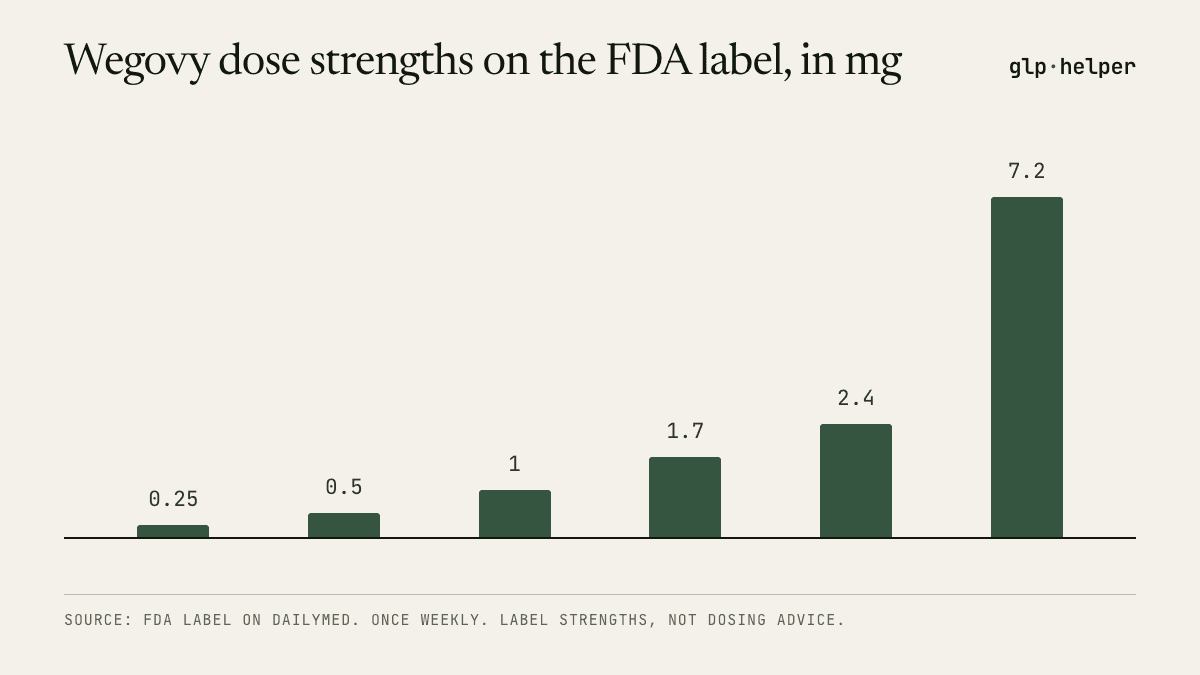
Weight effects typically begin within 4 to 8 weeks of starting titration. Most weight loss accrues during the first 6 to 9 months. The dose escalates over 16 weeks (0.25 → 0.5 → 1.0 → 1.7 → 2.4 mg) to the maintenance dose. Maintaining weight loss requires staying on the medication; weight regain is common after discontinuation.[4]
Same molecule (semaglutide), different FDA-approved indication and maximum dose. Ozempic is approved for T2D at doses up to 2 mg/week. Wegovy is approved for chronic weight management at doses up to 7.2 mg/week (Wegovy HD). Insurance treats them as separate drugs even though the active ingredient is identical.[1]
Yes in most states. The provider must be licensed in your state, and an established practitioner-patient relationship is typically required, which can be created via synchronous video visit per most state medical-board rules.[7]